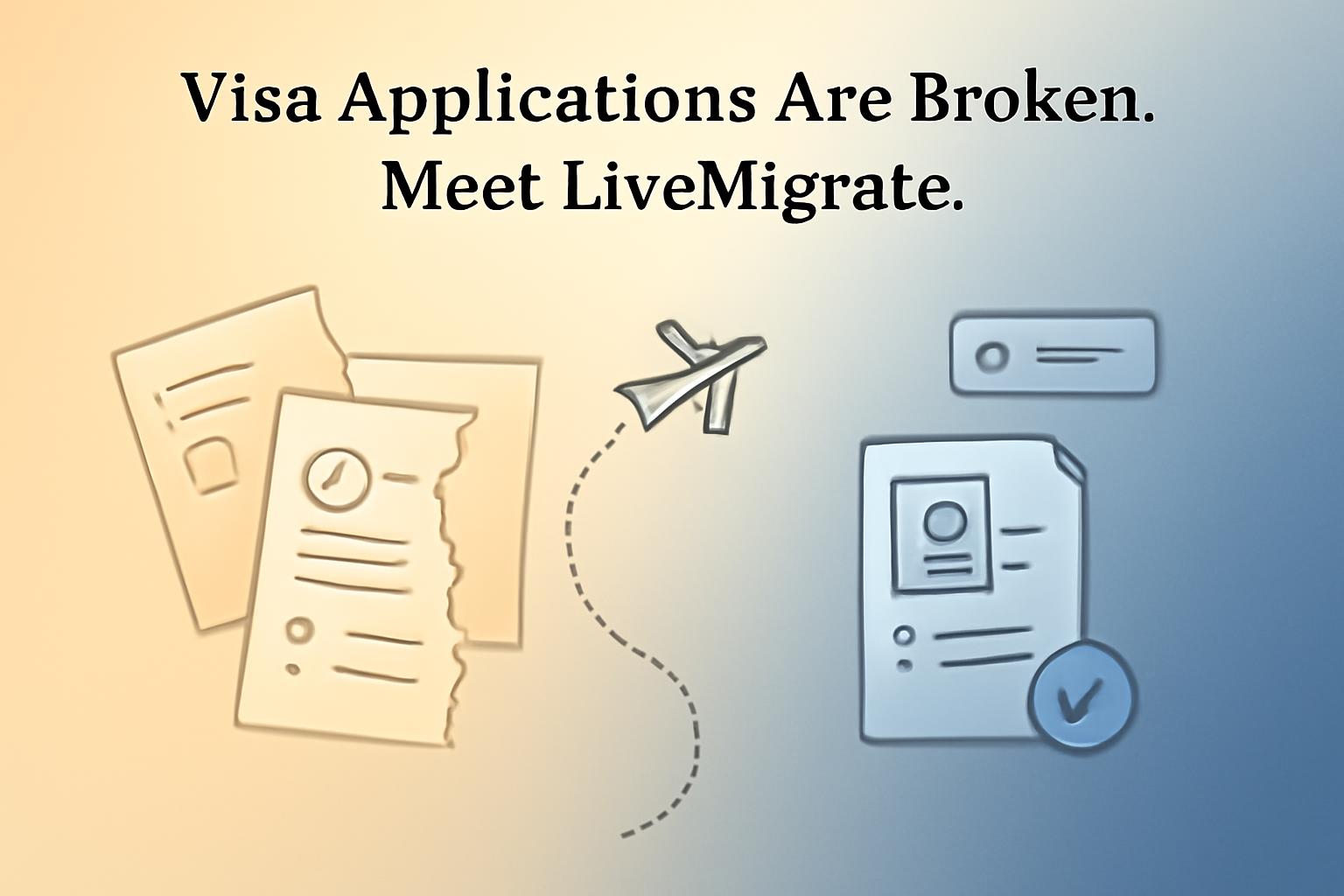
Visa Applications Are Broken. Meet LiveMigrate.
Travel paperwork is still repetitive, easy to misread, and stressful to manage. LiveMigrate launches with Canada eTA support to help travelers complete applications more clearly, accurately, and with less friction.
Why this launch matters now
If you travel internationally more than once, you already know the strange part of modern mobility: crossing borders has become routine, but the paperwork around it still feels stuck in another era. You may be flying for work, visiting family, starting a program abroad, or planning a short trip that should be simple on paper. Yet the application experience often feels fragile. You re-enter the same passport details. You second-guess ordinary questions. You search old emails for prior information. And even when the process is supposed to be straightforward, it is still easy to feel one typo away from a problem.
That gap matters because travel paperwork is no longer a rare administrative event for a small group of people. It is recurring infrastructure for students, skilled workers, families, remote professionals, and frequent travelers. The world has become more cross-border. The forms have not.
LiveMigrate launches into that reality with a practical first step: Canada eTA support. The idea is simple, but important. A legitimate government application should not feel harder than it needs to be. People should be able to understand what they are being asked, reuse the information that does not change, and move through the process with less confusion and fewer preventable mistakes.
This is not a promise to change official rules or guarantee outcomes. It is a commitment to making the process around those rules clearer, calmer, and more manageable.
The short version
LiveMigrate exists because travelers should not have to rebuild their identity from scratch every time they apply for travel authorization.
The real problem with travel paperwork
Most applicants are not frustrated by the idea of compliance itself. People understand that governments need identity details, eligibility answers, and supporting information. The real stress usually comes from everything layered around the requirements: repetitive data entry, unclear wording, scattered instructions, and forms that are easy to complete incorrectly when you are tired, rushed, or unsure what a field actually means.
That friction seems minor until it affects something important. A small passport-number typo, an inconsistent answer between applications, or a misunderstood question can trigger avoidable stress. Even when the case is simple, the experience often is not. That mismatch is why so many people describe travel paperwork as mentally expensive even when the form itself is not very long.
For repeat travelers, the burden compounds over time. One trip turns into another. A student later applies for a different status. A worker manages their own travel, then a spouse's or child's. A founder attends conferences in several countries in one year. But the systems rarely treat that person as a continuing applicant with reusable information. They treat every application like a fresh start.
What users struggle with most
- Re-entering the same identity details across separate applications
- Interpreting official wording without plain-language help
- Keeping answers consistent over time
- Losing track of progress across portals, inboxes, and saved screenshots
- Rushing because a form is harder to pause and resume than it should be
- Worrying that a "small" answer may be more important than it looks
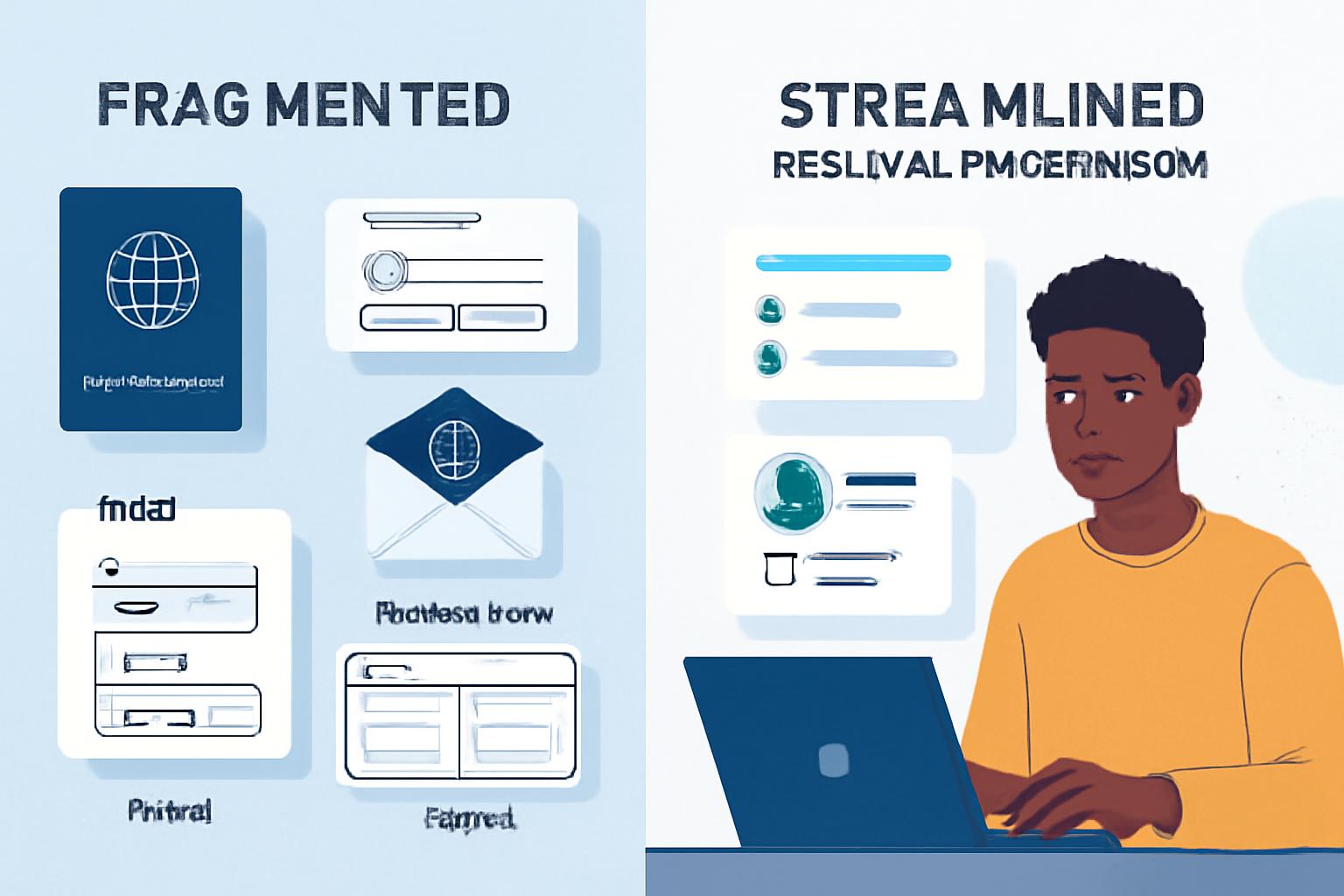
A simple comparison
| What travelers actually need | What many systems still feel like |
|---|---|
| Reuse stable personal data securely | Start from zero each time |
| Clear guidance before answering | Dense instructions after confusion starts |
| One place to track progress | Multiple tabs, emails, and reference numbers |
| Error prevention before submission | Mistakes noticed late |
| A workflow built for humans | A form built mainly for data intake |
Key takeaway
The pain point is not that people dislike rules. It is that too much avoidable friction sits between the traveler and a valid application.
Why the experience still feels outdated
It is fair to ask why this problem persists. Travel authorization and immigration systems are important, high-stakes systems. They process huge volumes of applications. They handle compliance, security, and eligibility at scale. So why do they still feel so manual from the applicant side?
One reason is structural. Official systems are usually designed first for correctness, security, and case handling. Those priorities are necessary. But they do not automatically produce a good user experience. A portal can be compliant and still be confusing. It can capture every required field and still leave a traveler unsure whether they understood a question correctly.
Another reason is that the support layer around official systems is inconsistent. Some applicants hire professionals. Some rely on friends and family. Others piece things together from articles, forum posts, screenshots, or memory from a previous trip. For straightforward travel authorization, full-service support may feel excessive. But doing everything alone can still be stressful. That leaves a wide middle gap: people who do not need full representation, but absolutely do need better workflow support.
Why manual workarounds survive
People create their own improvised systems because the official experience often gives them no continuity. Common examples include:
- Saving passport scans in random folders
- Copying details from an older application
- Searching email threads for reference numbers
- Keeping deadline reminders in a notes app
- Asking group chats to interpret a question
The deeper issue
Traditional form systems are very good at collecting answers. They are less good at helping people interpret questions before they answer them. In mobility workflows, that distinction matters. Most anxiety happens during completion, not after. Users do not just need a place to type. They need guidance while they are deciding what belongs in each field.
The biggest usability gap in travel paperwork is not data entry alone. It is the lack of timely interpretation before a mistake happens.
Key takeaway
The experience still feels old because most systems were designed to receive information, not to guide users through ambiguity, repetition, and real-life interruptions.
Why AI is finally useful here
A lot of AI product claims in high-stakes industries deserve skepticism. Travel and immigration are no exception. If AI is presented as a magical shortcut, people should be cautious. The useful role of AI here is narrower, and therefore more credible: helping applicants understand questions, complete workflows step by step, reuse information carefully, and catch preventable issues before submission.
That is where the technology becomes genuinely practical. A good system does not sit beside the process like a generic chatbot. It works inside the workflow. It can explain a field in clearer language, surface missing details, flag a possible mismatch, and help the user move through the application in a more structured way.
This matters because many travel applications are not hard due to volume alone. They are hard because they create uncertainty. Applicants are often willing to answer honestly and provide what is required. What they fear is misunderstanding the question, forgetting something small, or entering an answer that does not align with another part of the form.
Where AI actually helps
- Turning formal or technical wording into plain-language guidance
- Breaking long forms into manageable steps
- Spotting incomplete or potentially inconsistent entries
- Reusing stored profile data where appropriate
- Reducing repetitive re-entry for returning users
- Supporting pause-and-resume without losing context
What AI should not pretend to do
- Guarantee approval
- Override official eligibility criteria
- Replace government decision-making
- Make every application low-risk
- Remove the need for applicant review
Why now feels different
Earlier generations of “smart forms” mostly meant better design. That helped, but only up to a point. What is different now is that AI can provide live, contextual help inside a structured flow. Instead of just displaying fields more nicely, it can help users understand what to check before they move on.
Key takeaway
AI matters here when it improves comprehension and completion quality inside the application itself, not when it tries to sound more powerful than it is.
What LiveMigrate launches with
LiveMigrate launches with a focused first use case: Canada eTA applications. That focus is a strength. Good migration products do not start by trying to handle every country and every pathway at once. They begin with a real workflow where better guidance, reusable data, and cleaner completion can immediately reduce friction.
The core product idea is straightforward: the traveler should be the durable unit, not the individual form. If your passport details, identity information, and stable personal data have already been entered carefully, a modern system should help you reuse that information responsibly. If a question is confusing, the product should explain it before confusion turns into a mistake. If you need to pause, the system should remember where you were without forcing you into a rushed finish.
At launch, LiveMigrate is built for people who want a clearer path through Canada eTA paperwork without managing the whole process through screenshots, copied notes, and memory.
Launch features
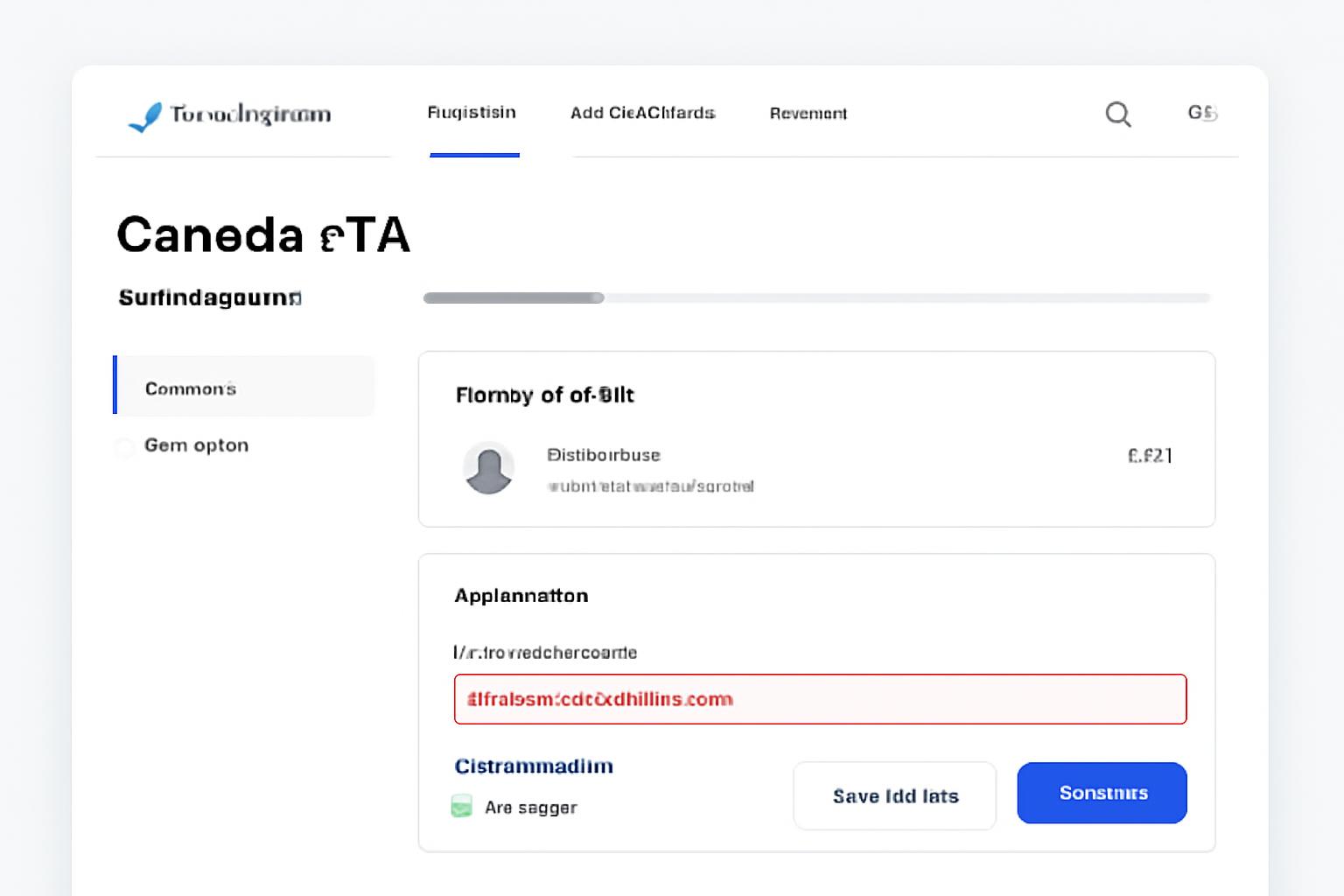
- Canada eTA application support
- AI-guided step-by-step flow
- Reusable traveler profile
- Save-and-resume functionality
- Applicant dashboard
- Secure checkout and organized submission flow
Who gets the most value first
- Travelers applying for a Canada eTA and wanting more clarity
- Repeat international travelers tired of retyping the same information
- Families managing more than one applicant
- Students and workers who care about accuracy, not just speed
- Users who are comfortable handling their own case but want a better process
Why starting narrow is the right move
A focused launch is often more useful than a broad one. Canada eTA is specific enough to build a polished workflow around, but common enough to prove whether guided migration software really reduces friction in practice.
Key takeaway
LiveMigrate begins with Canada eTA support, but the larger product idea is continuity: one traveler, reusable data, fewer avoidable mistakes.
How the product works in practice
The best launch posts do not stop at vision. They explain what the experience actually looks like. LiveMigrate is designed as a guided workflow rather than a blank static form. The point is not simply to digitize an application. It is to make completion easier to follow, easier to review, and easier to return to later.
That matters because many form errors are not dramatic. They are ordinary mistakes made under mild stress: a skipped field, a mismatch in spelling, a wrong digit copied from memory, or a rushed answer to a question that deserved one more read.
A practical step-by-step flow
1. Create your traveler profile
Enter core personal and passport details once, using official documents.
2. Start the Canada eTA workflow
Move through a guided sequence rather than a wall of questions.
3. Use field-level explanations
Get clearer guidance where wording might otherwise feel technical or vague.
4. Review validation prompts
Catch missing details or possible inconsistencies before moving forward.
5. Save and resume if needed
Pause without losing context if you are interrupted.
6. Submit through an organized flow
Complete the application in one structured environment.
7. Track everything in a dashboard
Keep your application status and core information in one place.
Why reusable profiles matter more than they seem
Reusable profiles are not just convenience features. They reduce one of the biggest hidden sources of form problems: repeated manual transcription of stable information. Every time a traveler retypes the same passport number, date of birth, or full legal name, there is another chance for inconsistency. Careful reuse saves time, but more importantly, it improves continuity.
Product snapshot
| Feature | Practical benefit |
|---|---|
| Guided flow | Makes the process easier to follow |
| Plain-language explanations | Reduces question misinterpretation |
| Reusable profile | Cuts repeat data entry |
| Save and resume | Prevents rushed completion |
| Dashboard | Centralizes application management |
| Structured review prompts | Helps catch simple mistakes earlier |
A realistic user example
Imagine a traveler planning a short work trip to Canada. They have applied for travel documents before, but not recently. In a traditional workflow, they might bounce between a government portal, old emails, a passport scan folder, and a notes app. In a guided workflow, they can gather their details once, complete the steps in order, pause if needed, return later, and review key fields before submission. The result is not magic. It is simply less fragile.
Key takeaway
The product is designed to improve one concrete outcome: finishing legitimate travel paperwork with less repetition, less ambiguity, and more control.
The bigger vision beyond one application
It would be easy to describe LiveMigrate as a Canada eTA product and stop there. That would undersell the actual opportunity. The recurring problem is bigger than one country and one authorization type. It shows up across visas, travel permissions, student pathways, work mobility, family travel, and business travel.
People move across systems over time, but the administrative burden follows patterns. They repeatedly need to organize identity details, understand official wording, keep records consistent, store documents safely, and avoid conflicts between forms. That is why the long-term opportunity is not “one form, completed faster.” It is a durable mobility layer that becomes more useful as a person crosses borders more often.
This is also why the planned expansion areas matter. UK visas, USA travel applications, Schengen workflows, Australia-related travel processes, B2B tools for agencies, and corporate mobility support all share a common operational challenge: repeated intake, repeated clarification, repeated validation, and repeated tracking.
What the future likely looks like
The most realistic future is not one universal app replacing every official government system. That is unlikely. A more useful future is a persistent support layer between travelers and many official systems: a place where people prepare information once, reuse what is reusable, and navigate country-specific processes with more continuity.
Why this matters for organizations too
The same problem exists at scale for travel advisors, employers, relocation teams, and mobility operations. Cleaner intake, fewer follow-up questions, better record management, and clearer workflows are not just user benefits. They are operational benefits.
Suggested title options
As requested, here are five launch-style title ideas aligned with the product and audience:
- The Smart Way to Migrate
- Visa Applications Are Broken. We’re Fixing the Workflow.
- Meet LiveMigrate: A Better Way to Handle Travel Paperwork
- Rethinking Global Mobility, Starting With Canada eTA
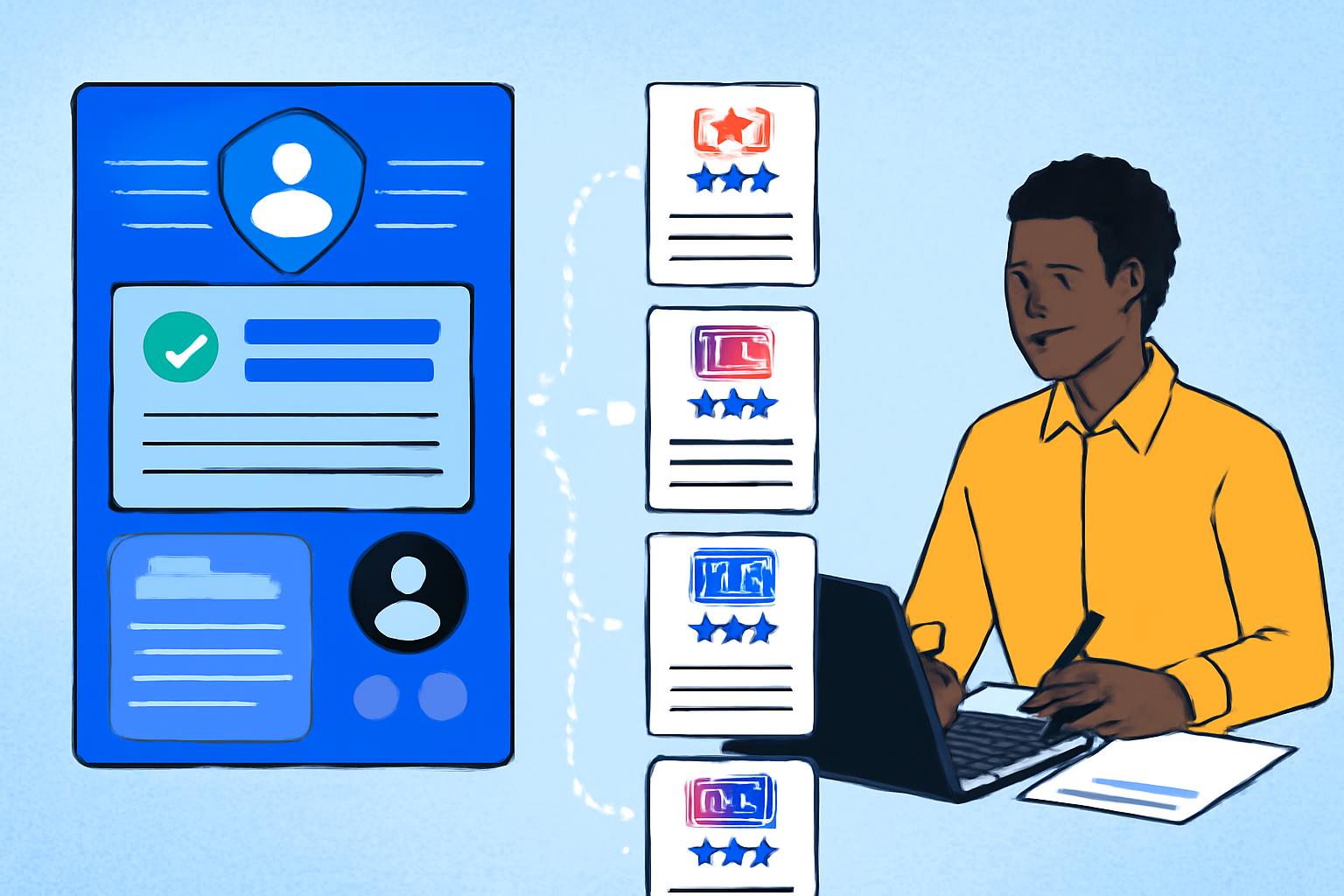
- We’re Building a Reusable Layer for Visa and eTA Applications
Key takeaway
The ambition is not to replace official platforms. It is to build the reusable infrastructure layer that helps people navigate those platforms more effectively over time.
Where automation still falls short
This is the part responsible launch posts should include: better software does not remove the need for judgment. In immigration and travel compliance, that limitation matters. Smooth design can lower friction, but it cannot lower the stakes of an inaccurate answer.
LiveMigrate can help users stay organized, understand questions more clearly, and reduce preventable mistakes. It cannot change eligibility rules, guarantee outcomes, or convert a complex case into a simple one. If a traveler enters incorrect information, no interface can make that safe. If a case involves prior refusals, unusual history, or facts that require interpretation, software support is helpful but not always sufficient.
This is also where a slightly contrarian point matters: not every painful part of travel paperwork is a design flaw. Some friction exists because the decision itself matters. The right product response is not to pretend that all complexity should disappear. It is to remove unnecessary friction while preserving careful review where it belongs.
Cases where extra caution matters
- Prior visa refusals or complicated immigration history
- Multiple applicants whose answers must stay fully consistent
- Missing or hard-to-verify information
- Situations where memory is being used instead of records
- Applications being completed under time pressure
A grounded way to use migration software
Use software to:
- Organize your details
- Understand questions before answering
- Reduce repetitive typing
- Catch obvious omissions or mismatches
- Keep records and progress in one place
- Verify passport details character by character
- Re-read sensitive answers before submission
- Check official documents instead of guessing
- Slow down when a question seems simple but important
- Seek specialist support if your case stops being straightforward
Key takeaway
The best role for AI in migration is careful support. Human review matters more, not less, when the stakes are high.
Practical next steps before you try LiveMigrate
If your immediate goal is a Canada eTA application, the best way to benefit from a guided platform is to prepare before you start. Smarter workflow tools work best when the information going in is accurate. The users who get the cleanest experience are usually not the fastest clickers. They are the people who spend a few extra minutes upfront gathering the right details.
A little preparation can reduce a lot of avoidable stress later. That is especially true for travelers who are juggling flights, hotel bookings, family coordination, or work deadlines at the same time.
Pre-application checklist
Before you begin, have these ready:
- Your current passport
- Your personal details exactly as shown on official documents
- Access to your email account
- A payment method for completion steps
- A quiet 15-30 minute window if possible
- Any travel or background details you may need to confirm
How to avoid common preventable mistakes
- Do not rely on memory when a document is available
- Do not copy old details forward without checking them again
- Do not rush because the application seems short
- Do not ignore validation prompts without reviewing them
- Do not wait until the last minute before important travel
A simple best-practice workflow
1. Put your passport in front of you.
2. Create your traveler profile carefully.
3. Read the explanation whenever a field feels ambiguous.
4. Use save-and-resume instead of guessing under interruption.
5. Review the key identity fields one final time.
6. Keep confirmation records once you finish.
Conclusion
LiveMigrate launches with a focused promise: not shortcuts, not inflated AI claims, and not guarantees. Just a better way to handle legitimate travel paperwork. Starting with Canada eTA support is a practical first step toward something larger: a reusable, intelligent layer for global mobility.
If you are planning travel and want a clearer, more organized way to complete your Canada eTA application, this is the right moment to try it. Explore LiveMigrate, set up your traveler profile, and see what a calmer application workflow can feel like.
CTA
Visit https://livemigrate.ai to explore the launch and start your Canada eTA application with a more guided workflow.
FAQ
What does LiveMigrate support at launch?
LiveMigrate currently launches with Canada eTA application support.
Does LiveMigrate make immigration decisions?
No. Official decisions remain with the relevant government authorities. LiveMigrate helps users complete and manage the application workflow more clearly.
What is the practical value of AI in the product?
It helps explain questions, guide users step by step, surface possible inconsistencies, and reduce avoidable mistakes before submission.
Who is it best for right now?
It is especially useful for travelers who want a clearer Canada eTA workflow, including repeat travelers, families, students, and workers who care about accuracy and organization.
Can a guided platform replace careful review?
No. You should still verify your details, read questions closely, and seek human help when your case is not straightforward.
Final takeaway
The strongest reason to care about LiveMigrate is simple: international mobility is increasingly normal, but the paperwork experience is still too repetitive and too easy to get wrong. A better support layer will not remove the rules, but it can make following them much less painful.
Canada eTA
Ready to travel to Canada?
Apply for your Canada Electronic Travel Authorization online. Quick, guided, and approved in minutes.
Browse by topic